1. Uvod
This document outlines the ISO 182-4:1993 standard, which specifies a potentiometric method for determining the tendency of compounds and products based on vinyl chloride homopolymers and copolymers to evolve hydrogen chloride and any other acidic products at elevated temperatures.
This standard is crucial for assessing the thermal stability of PVC materials by quantifying the release of acidic gases under controlled conditions.
2. Namen in področje uporabe
The primary purpose of this method is to provide a standardized procedure for evaluating the thermal degradation characteristics of PVC materials. It focuses on the evolution of hydrogen chloride (HCl) and other acidic by-products, which are key indicators of material stability.
This method is specifically recommended for compounded PVC materials and products. While it can be applied to polymers in powder form, appropriate conditions must be ensured for accurate results.
3. Methodology: Potentiometric Method (Operating)
3.1. Načelo delovanja
The core principle involves maintaining a test portion of the PVC material at a predetermined, agreed-upon temperature. This is done within a controlled nitrogen gas stream.
3.2. Hydrogen Chloride Absorption
As hydrogen chloride (HCl) evolves from the heated PVC, it is absorbed into a specified amount of an appropriate solution. This solution acts as a medium to capture the acidic gases.
3.3. Potentiometric Determination
The amount of evolved hydrogen chloride is then quantitatively determined by potentiometry. This involves measuring the change in the pCl (negative logarithm of chloride ion concentration) of the absorbing solution. The recorded change in pCl directly correlates to the amount of HCl released.
4. Applicability and Considerations (Setup/Maintenance)
4.1. Recommended Materials
This method is primarily designed for and recommended for use with compounded PVC materials and finished products. This includes various forms of PVC that have undergone compounding processes.
4.2. Powdered Polymers
While the method can be adapted for polymers in powder form, it is essential to establish and maintain appropriate testing conditions to ensure the validity and comparability of results. Specific considerations for sample preparation and handling may be necessary.
4.3. Nastavitev opreme
Proper calibration and maintenance of the potentiometric equipment, temperature control systems, and nitrogen gas flow are critical for accurate measurements. Refer to the full standard document for detailed equipment specifications and setup procedures.
5. Specifikacije
| Standard Identifier | ISO 182-4:1993 |
| Založnik | Multiple. Distributed through American National Standards Institute (ANSI) |
| Datum objave | 23. avgust 2007 |
| Jezik | angleščina |
| Dolžina tiskanja | 24 strani |
| Teža predmeta | 3.84 unč |
| Dimenzije | 8.25 x 0.06 x 10.5 palcev |
6. Odpravljanje težav
This section provides general guidance for common issues encountered during the application of the ISO 182-4:1993 standard. For detailed troubleshooting, refer to the complete standard document and relevant laboratory best practices.
- Nedosledni rezultati: Ensure all equipment is calibrated correctly, reagents are fresh, and environmental conditions (temperature, nitrogen flow) are stable and within specified tolerances. Verify sample preparation consistency.
- Low HCl Evolution: Preverite sample integrity and ensure the test temperature is accurately maintained. Confirm the nitrogen gas stream is free of contaminants that could interfere with the reaction or absorption.
- Potentiometer Instability: Verify electrode functionality, ensure proper electrolyte levels, and check for any electrical interference. Recalibrate the potentiometer before each test series.
- Difficulty Absorbing HCl: Confirm the absorbing solution is correctly prepared and sufficient in volume. Check for blockages in the gas flow path.
7. Dokument Konecview
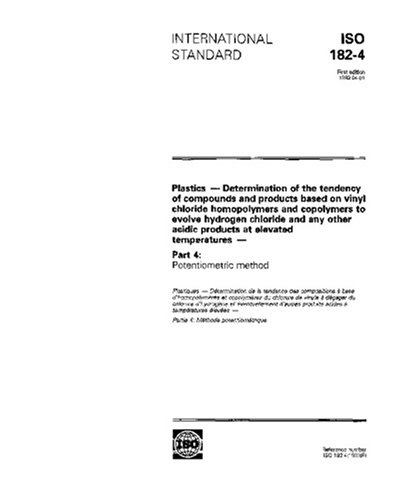
Figure 1: Cover page of the ISO 182-4:1993 standard document. This image displays the official title and standard number, indicating its focus on the potentiometric method for assessing hydrogen chloride evolution from PVC materials.
8. Garancija in podpora
As this document is an international standard, it does not come with a traditional product warranty. For support regarding the interpretation or application of the ISO 182-4:1993 standard, please refer to the issuing body, ISO (International Organization for Standardization), or the distributing organization, American National Standards Institute (ANSI).
Official contact information and resources can typically be found on their respective webspletna mesta:


